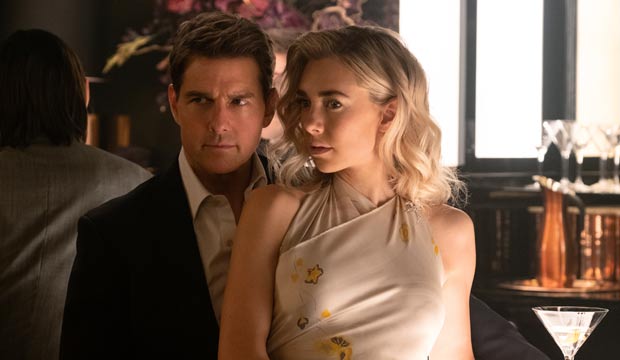
Showing posts with label Vanessa Kirby. Show all posts

Friday, December 22, 2023

Napoleon (2023)

Napoleon Blown Apart
or
Ridley Scott Tells Complaining Historians To "Get a Life" (Presumably One With Just the Highlights)
 
I'd been vacillating whether to see Ridley Scott's film of Napoleon (was it really originally called "Kitbag"?)—did I want to see the 2 hour 38 minute version in the theaters, or did I want to subscribe to Apple television and watch Scott's already-made "Director's Cut" which is more than 4 hours long?* 
 
I tend to favor "Director's Cuts" because a lot of movies cut to theater-length are sometimes near-incomprehensible once the connecting tissue of themes and sub-plots get eliminated for time. But then, some "Director Cuts" are just plain indulgent. A movie's "first cut" is always a disaster (Martin Scorsese has said “If you don't get physically ill seeing your first rough cut then something's wrong."), but films are supposed to find their shape and their rhythm during the editing process and sometimes the more brutal the better.
There's a "Hollywood story" where director Robert Rossen wasn't happy with the length of his film All the King's Men (and neither was the studio), so he merely took "the center" of each scene and cut 100 feet from the front of it and 100 feet from the back and released it like that. The film went from a length of 250 minutes to 109, and won the 1950 Best Picture Oscar (and was nominated for the editing).
The decision for me was seconds long in the thinking—all this other stuff was back-story—I went with the theatrical version (I could always look at the longer one) and Scott is usually pretty good at getting the gist of the story he wanted to tell in the shorter running times. And his films at the shorter length tend to be "snappier" and less padded and one doesn't get the sense that one is missing anything. With a subject like Napoleon Bonaparte (played by
Joaquin Phoenix), though, there is bound to be omissions, whole swaths of them. Scott's film follows Bonaparte from the French Revolution in France in 1789 until his death in 1821.
Toulon
The highlights are his witnessing of the death of Marie Antoinette (didn't happen) during the Revolution, his Siege of Toulon, his controversial quelling of a civilian rebellion in 1795, his campaign against Egypt in 1798, his taking control of France in a coup in 1799, his coronation as Emperor in 1804, and a bit of the Napoleonic Wars, particularly the Battle of Austerlitz, and his ill-fated Invasion of Russia in 1812, leading to his exile in Elba, his subsequent return to France, the Battle of Waterloo, and his final exile on St. Helena. That's a lot of territory and politics to cover with a big gap in places before his becoming Emperor and during the Napoleonic Wars, although those battles listed are given quite a bit of depth.
Swirling around all of this is Napoleon's obsessive marriage to
Joséphine de Beauharnais (played in the film by Vanessa Kirby), whom he meets at a Survivor's Ball after the Reign of Terror—her first husband was guillotined and she was in prison during it—and begins an affair that informs and influences some of Napoleon's decisions (yes to some, no to others the movie would have you think). Those scenes have less fire-power, but they're still battles of wills as they bicker and bite over who has control over the other, Joséphine's indiscretions (and Napoleon's, too), her inability to provide him a male heir leading to their marriage annulment and his subsequent political marriage to the Austrian Emperor's daughter, Marie Louise. (It's rather amazing that Scott's film is only 2½ hours long! Abel Gance's "definitive" cut of his Napoleon film ran for nearly 9½ hours and only got up to the marriage of Joséphine!)
Performances are good throughout, the standouts are Kirby and 
Rupert Everett's Duke of Wellington. The big pressure, of course, is on Phoenix, as Napoleon has always had a Sphinx-like quality to him, and what we know of him is his accomplishments, his many portraits, flattering and unflattering depending on the nationality of the painter, and his letters to Joséphine (many of which are quoted in voice-over in the film). Phoenix manages to keep his Napoleon as unknowable after the film as before—imperious in matters of State and war, but almost petulantly child-like in moments of lust or humiliation, very much in command backed by great numbers, but a bit panicky when having to act solo. There is the whiff of "keeping up appearances" when given to a grandiose equating of his fortunes with those of France, but, there are times in the private chambers when Phoenix can't overcome some lame dialog ("Destiny has brought me here. Destiny has brought me this lamb-chop.")
Some of Scott's more arresting shots are based on period paintings.
Phoenix could have been a cardboard cut-out for all Scott cares during the battle sequences. They're staged brilliantly with the emphasis on numbers and the only identifiable character is Napoleon, whether he's catching a cat-nap on his feet before a battle or deciding the fate of many with just the drop of an arm. Scott has had lots of research to draw on, and one sees the way they unfold without any coaching about tactics. The Austerlitz battle is particularly impressive. Scouts signal by lights the positions of the enemy, which Napoleon enables to come to a seemingly sleep encampment. Then once his enemies are deep within their territory, he unleashes camouflaged infantry from the hills, provoking a retreat. But, the battle isn't over. The cannon are uncovered and fired deep into their own camp, forcing the troops into another direction...onto a frozen lake, allowing Bonaparte to unleash cannon-fire that either kills troops or breaks the ice, sending them to a watery frozen grave with no escape. Brutal.
The trap of Austerlitz
I'm always a little suspicious going into a Ridley Scott movie (violating a rule to enter a theater without prejudices). There are a lot of good ones and there are some quite bad ones. All are made with an attention to detail and artistic zeal—if I haven't written it, I've thought it: he's a better art director than a director, which is a little harsh—but, the quite good ones are those where the stakes might be a little lower than the "buzz"-generating ones. In one year, he made two movies—The Last Duel and House of Gucci—the first was quite good, but was little-seen, while Gucci was a self-generating publicity machine that was a mess. And one can go through his entire output and look at the ones that were triumphs (whether humble or not) and audacious failures, quite the checkered career. But, they always looked good. That much is consistent.
Moscow burns, but not by him.
And I tend towards saying Napoleon is good, despite its eccentricities. The battle sequences are amazing whether channeling the battle approaches of Kubrick, Welles, or Jackson, and some will be impressed with how Scott really goes for re-creating famous Napoleon tableaux into living, breathing set-pieces. But, I like it for following the Kubrick model** for considering Napoleon—the same theme that informed a lot of Kubrick's work: no matter how smart or able a human being might be, they can be undone by their own faults. Successful people can be destroyed by their very nature. Geniuses can be very stupid.
 "Well...shall we vote?" No recounts necessary.
It's a comedy. Not a very funny one, but certainly an ironic one. There is some black comedy to be had with such a person as publicly arrogant and as privately sniveling as Napoleon could be, whose ambitions were the world, but could be cowed in the bedroom. Scott follows that model to a fleur-de-lis. It is said that Scott considered making the Kubrick script, but passed on it for "creative differences", and made something of his own. But, it still has the spine and the thesis of the unmade Napoleon film at its core, and something of the French 2002 mini-series in its portrait recreations.
If I have a quibble it would be with the last scene, presumably showing Napoleon's death at St. Helena. Dramatically, it doesn't work, although it does work visually—Napoleon seen from behind, eating a mid-day meal, merely falls over out of frame. It's almost absurd. But, it does make a point: this powerful man, a former emperor of a great and powerful nation, who once had the world playing defense against his every move merely disappears, and the scene goes on—life goes on—as if he never existed. It visually makes the point that death makes us all equal, even irrelevant. Still, it's a bit underwhelming.
An underwhelming death for such a world-shaking individual. Irony, again. And then, Scott and his screen-writer (
David Scarpa) tally up the deaths from his battles and campaigns. Three million. Three million souls. We know very little about them—their numbers are just too great—but they all have something in common. They were all people whose deaths were the results of the actions of one man, a man of consummate ambition, with his own vision of what the world should be, not satisfied with his own borders or the extent of his domain. They were caught up in the gears of one man's machinations.
And when given the first opportunity, when his reach exceeded his grasp, the world found a way to deal with him that was far less costly in political capital, and the various monetary denominations he would waste, and the blood that he would spill. They sent him away, exiled him, found a little rock that he could rule over, and when he escaped from that, they found a farther-away little rock with no rule at all and left him there to rot. After all, better him than them.
Waterloo
What else could they do with such a man? His punishment and possible execution would have caused too much unrest, and might have even made him a martyr to his supporters. No, the best punishment was to get him out of their sight and out of his spheres of influence. For such a man of power, the worst thing they could do was take his power away. Napoleon was just one man who so destabilized the world that he was just too dangerous to the peace and tranquility to not be exiled to a place where he could do no harm. The world would be better off without him and there would maybe be better things to think about and act on. The world might actually be improved, rather than merely re-shaped to suit a man's ego. 
Wellington and  Napoleon 
St. Helena is still out there, and I'm sure it has some vacancies.

Got anybody in mind?
Napoleon and Joséphine
* I still find it unfair that George Lucas has perpetually been criticized for tinkering with his movies (usually because the special effects looked sub-par on better TV's, or because he wanted to add things that he didn't originally have the budget for). But, Scott's been doing it for years and years and years, and because he always had to shred his movies to get them to an acceptable run-time in theaters...or because he was dithering with them long after the fact. See also Oliver Stone, Francis Ford Coppola, and Zack Snyder.
 
** Stanley Kubrick worked on a screenplay on the life of Napoleon for some ten years. He did extensive research, logistics, costume tests, location scouting, and had a full screenplay ready to shoot.*** He'd just had two successful films with Dr. Strangelove and 2001: A Space Odyssey and negotiating with M-G-M to finance it. They rejected it. The reason? The financial failure of the film Waterloo. Kubrick abandoned the idea, but it influenced his next two films: he made A Clockwork Orange to use the new wireless audio technology in audio, and to really make an independent film with a minimum crew, and Barry Lyndon with the idea of trying to achieve painterly compositions photographically, simulating the pace of the 18th century, and staging large artillery battles. Steven Spielberg is executive producing a mini-series for HBO, and (as of this writing) it's still on track, with Cary Joji Fukunaga directing. We'll see if the project gets derailed again by a rival production (as it was the first time). However, if one checks out their movie history, there's usually some "take" on Napoleon every decade or so. 

*** The screenplay sits on my home-screen half-read, but a deluxe box-set of the script and all the pre-production material can be purchased.

Wednesday, July 12, 2023

Mission: Impossible—Dead Reckoning, Part 1

"Couldn't You Have Told Me This a Little Bit Sooner?"
or
"Is There Anyone Not Chasing Us?"
 
One can't start out a review of Mission: Impossible—Dead Reckoning (Part 1) without giving props. It is one busy movie, filled with some amazing stunt work and a dedication to craft that one shakes their head in amazement that these things were thought up and brought to some spectacular life. The immediate reaction to one of these things evokes horror and then giggles as they are pain-stakingly realized to convince you that 1) they actually happened and 2) that they actually COULD happen. And a rueful head-nod must go to "Mr. Gung-Ho" Tom Cruise for putting himself "out there" just because he could. One has to say all this, because for the most part this review will trash this entry in the franchise, surely its weakest entry since Mission: Impossible 2.
 
But, wow, those stunts sure are amazing. The trouble is that's what the movie is all about, the stunts and those alone have never made a good movie. What they show is that the characters have an abnormal survival instinct and the tenacity of pit-bulls to pull though whatever obstacle can be thrown, dropped, propelled and fired at them. And that's it for character development. Oh, there's some ret-conning about "how Ethan Hunt became Ethan Hunt" as well as other agents into the IMF, but it's as unsubstantial as...well, as the entire make-up of the IMF apparently is in the spy hierarchy if we're to believe this movie.
The mission this time (should we decide to accept it, and I, frankly, didn't) is to recover the latest "McGuffin" in the series, the two-part "Cruciform Key", which is used to power up "an active learning defense system" which is touted by its Soviet creators as "the state of the art of war." Timely, since we're all worried about AI (and this is where I insert my "written by human hands" disclosure). The Vicious Thingy was last seen on board the Soviet submarine K699, the Sebastopol, which sits at the bottom of the Bering Sea a victim of its own system's ability to present false data to the sub crew causing them to launch a torpedo attack against a ghost target and blowing themselves up. This is one nasty little AI that can wreak havoc on countries and their defenses, but the world's governments don't want to destroy it, so much as control it. World leaders tend to have a lot of hubris; who wants to bet that they learn a lesson in humility in Part 2?
IMF agent Ethan Hunt (Cruise), despite his"habitual rogue tendencies," is enlisted to find the key. Who has it? Ilsa Faust (Rebecca Ferguson), late colleague, who is not so late and has one-half of the key. Hunt and the team (Ving Rhames and Simon Pegg) decide to go after the other half of the key, where they run into an atomic bomb trap (okay) and a pick-pocket named Grace (Hayley Atwell), who manages to lift the other half of the key from the prospective seller, complicating matters. Hunt also runs into a "face from the past" (Esai Morales), who seems to have the ability to not appear on surveillance systems. But, not the ability to make one of those full-head disguises that Ethan depends on in these movies.
What happens next? Chases. Lots of chases. Ethan and Grace are chased by land, foot, wheels, by the CIA, by Morales' "Gabriel"—along with Pom Klementieff's killing machine, Paris—by the forces of arms dealer The White Widow (Vanessa Kirby), by his own IMF Chief Kittridge (welcome back to the series, Henry Czerny!) by the local constabulary, and evidently anyone with a cell-phone or police scanner, until everyone meets on the Orient Express, and everything just goes literally right off the rails. Most of this is played with deadly earnestness, but one can't help but chuckle at the "Perils of Pauline" aspect of it, some of it is right out of silent movies.
But, the plot is a clunker. And the dialog at times is so vaguely inconsequential (and delivered so seriously) that you wonder if people are speaking in spy code. So, this entry in the series—the 7th—is overwhelming in stunts and underwhelming in story—and inventiveness—even though everyone bravely battles on.
I had much the same reaction to the very stunty recent Indiana Jones movie, which was only saved by a particularly risky (and fanciful) last act. This doesn't have something like that, but it does have another fight on a train with subsequent derailment, and another smashing car chase in a vehicle not built for those things.
 
The trailer for M:I7 exposed the weakness of the film by just showing stunts and fights, as that seemed to be all it has because, for the first time, they seemed to be borrowing from the James Bond series: the train fight from Octopussy, the Citroen chase from For Your Eyes Only becomes a Fiat 500e chase here, with Cruise and Atwell handcuffed as a similar situation in Tomorrow Never Dies, the whole "world-spy-network-hijack" idea comes from SPECTRE (notice that when the "Mission: Impossible" series borrows from Bond, it doesn't borrow from very good ones?), then that very hyped motorcycle jump has echoes of The Spy Who Loved Me. Usually, it's the Bond films that borrow from other films—maybe M:I is running out of ideas.
There are other odd little issues, like that director McQuarrie
(who has done some inspired work in previous film in the series) seems to have shot some dialog scenes using three cameras, that are edited in such a way that, when edited together, seems to have the actors not addressing each other in conversation. It's odd...and a little off-putting. Given the attention to detail in the action sequences, why would something like that occur?
 
Still, despite the reservations I have about the film, I hope it has a great box-office return. The film industry needs a little help right now, and this Summer's expected blockbusters have been under-achieving. A solid box-office return could reverse that trend, and help movie-makers battle the real-world challenges of AI.

Friday, August 3, 2018

Mission: Impossible—Fallout

The Perpetual "Mission" Machine
or
"We'll Burn That Bridge When We Come To It"

The sixth of the Tom Cruise "Mission: Impossible" films has slammed into theaters going 90, and it's getting rapturous reviews. Yeah, it's okay, but it's not the best of the series; the original and Ghost Protocol are the best, and the last one (which was also written and directed by Christopher McQuarrie)—of which this is a direct sequel—was quite good, too. McQuarrie must be scratching his head: "you mean I can have the barest bones of plot, but just make it wall-to-wall stunts, and people will love it more than if I make something really intricate? Who knew?"

Who, indeed? This one subtitled Fallout is cobbled together from elements of the other "Mission: Impossible" movies* as well as recent entries in the James Bond franchise (the first time in a long time that other movies are borrowing from them instead of the other way around), but the main thing it's borrowed from that series is a short-hand story-telling in service as lattice-work connecting the stunt sequences.

It's pretty basic stuff. 

Ethan Hunt is having those horrible foreshadowing nightmares you only get in the movies. They usually involve a Mission gone wrong, killing himself and those he loves in the process. Something goes BOOM! in the distance and they go boom in the shock-wave. Wake up! Time for a special delivery (special because it requires code-phrases). It's a Mission: the capture of Solomon Lane (Sean Harris)—from Rogue Nation—has not ended his menace. He has inspired a cult of terrorists called "The Apostles" who conduct attacks around the world. Led by a mysterious figure named "John Lark," they are attempting to acquire three stolen plutonium cores to be used to build nuclear bombs, designed by an extremist nuclear scientist Nil Debruuk (Kristoffer Joner). Hunt's mission—should he decide to accept it—is to intercept the sale and out-bid for it. As Lane says at one point: "I wonder, did you ever choose not to?"
Now might've been the right time; at the hand-off in Berlin, things don't go as carefully planned—Hunt and fellow IMF-er Benji Dunn (Simon Pegg) meet up with the sellers while Luther Stickell (Ving Rhames) does reconnaissance in a van some distance away. They're compromised and Hunt chooses to save his team-mates, and in the ensuing firefight, they lose the plutonium. Who has it? 
Turns out it's not The Apostles but some other bad people, led by a "broker" named "The White Widow" (Vanessa Kirby), who is to have a meeting with that "John Lark" in Paris in that most secure of locations, a disco. Given how well he did in the first-go 'round, IMF division head Alan Hunley (Alec Baldwin) assigns Hunt to track Lark and intercept the meeting, but Hunley is overruled by his boss at the CIA, Erica Sloan (Angela Bassett), who distrusts Hunt to get the job done and assigns him their best "minder," Agent August Walker (Henry Cavill) to keep him in his sights and in line.
Paris being a tough town to get into these days, Walker and Hunt stage a HALO jump (High Altitude-Low Opening) to land on the roof of the disco and infiltrate searching the crowd for Lark. The idea is to find Lark, incapacitate him, make a 3-D mask of his face and let Hunt impersonate him for the meeting with The Widow, but the guy they've tracked as Lark is a little tougher for them to take on—both Walker and Hunt are used as mops in a bathroom brawl, where the three pummel pusses and porcelain, and it is only the intervention of Ilsa Faust (Rebecca Ferguson, also from Rogue Nation) that keeps him from killing one or both of them. Unfortunately, though, amid her fortunate entrance into a men's room, she's killed the guy. "Could we still make the mask?" she asks. "You need a FACE to make a mask!" Hunt replies. 
So, they do what the IMF always does, they spit-ball—or, in the phrase Hunt uses throughout this one, "I'm working on it"—since no one knows what Lark looks like, Hunt elects to pose as him for the meeting with The White Widow—unfortunately, there are all sorts of assassins looking to take Lark out on sight and since his appearance with The Widow is a dead give-away, he and Walker and The Widow only make it out of the rendezvous by killing a few assailants among the bystanders. Some secret mission.
At the meeting, The Widow gives Hunt and Walker one of the cores and presents the price they must pay for the other two: spring Solomon Lane from captivity, which she has already carefully arranged for them, by creating a viable distraction, while Lane is being transported in Paris. As her thugs are a bunch of murderous sociopaths, Hunt conspires to do them one better with the help of Benji and Luther. They manage to capture Lane with as little collateral damage as possible except for the brick-and-mortar kind. 
But, it makes Walker suspicious: he tells his boss that it is his contention that Hunt is actually Lark, and that it's not just a pose. He thinks he's gone rogue, really, this time: "How many times has Hunt's government betrayed him, disavowed him, cast him aside? How long before a man like that has had enough?" All true, of course. Cruise's Hunt is the most trusted and LEAST trusted spy in the movies. And, not that he didn't understand it before, Walker is told to keep watching him, and if he can prove his suspicions, take Hunt out.
Cue music (Lorne Balfe does a fine job adapting Lalo Schifrin's iconic music, by the way), wind Cruise up and let him go. The remainder of the movie is, basically, chases—motorcycle, cross-country (or city, in this instance, which is London), and culminating in a helicopter chase in the mountainous terrain of India, with the purpose of getting the key widget of a doohickey that will allow his IMF team to stop the two nuclear bombs that are deployed nearby in a remote section of the country—why set them off in India as opposed to more populous cities is anyone's guess.
Cruise doesn't do all of the stunts—some of the motorcycle work is not him—but so much of the dangerous stuff IS him that you can't fail to be impressed...and come to the conclusion that the man is, basically, nuts, and must have one hell of an insurance policy.
He's obviously been watching the Craig Bond's and the "Bourne" films and saying "I could do that"—after spidering around Dubai skyscrapers and clinging to the outside of planes, jungle-gymming under helicopters might have seemed like a bit of a rest—"AND I can keep my face in the camera the whole time." Cruise's self-promotion is legendary, although it didn't help him when he was pin-balling through The Mummy and American Made.
Okey-dokey. Not sure that doing that actually improves the movie, or gets him in good with any stunt-person's union, but sure, big hand for Tom. Way to go, kid. You manage to keep the focus on yourself and make sure the audience is watching you no matter what is going on around you.
They needed to do something because the central mystery of the film—"who is John Lark?"—is easily suspected somewhat early on and confirmed half-way through the film. Not that it matters: as Bassett's Sloan says at one point, "The IMF is Hallowe'en"—it's part of the fabric of the Mission: Impossible series that no one is who they seem to be, by nature or latex disguise, and the gambit has been exhausted in the M:I series. One is hardly surprised by the reveal, because at that point, the film is on auto-pilot.
At this point in the film and the series, Mission: Impossible—Fallout has given up on interesting set-pieces—like the opera sequence in Rogue Nation or the Dubai hotel team-gambit in Ghost Protocol—and deception as its inspiration and just goes for the jugular with the hyper-activity of what has been termed "chaos cinema," that breed of action film begat by The Dark Knight, where you didn't need logic in your story-telling so much as momentum and spectacle. You could also go so far as ignore internal logic in a shot if it produced the desired "buzz" in the audience. Momentum keeps audiences from asking too many questions because the next shock dispels the memory of that question—it's quite effective in presidential politics, too! So, to borrow a phrase from the film, if the other films were scalpels, then this one is a hammer. A blunt instrument to beat out objections. Not too far afield from John Woo's strategy in Mission: Impossible II (and, as I remember, that one stunk).
Look, kids, despite everything that we've been shown the last few years in theaters, "kinetic" does not equal "great." It's one thing to move the camera, it's another thing to move the heart and the mind. And unfortunately, that's one mission that government-run spy agencies always seem to get wrong.
This is from the trailer but does not appear in the film....

* Well, Vanessa Kirby plays a character called "The White Widow" who is actually the daughter of "Max," Vanessa Redgrave's character from the first film, Ethan Hunt has to match wits with another agent as in M-I II, Michelle Monaghan is back as Hunt's...wife... from 3, who was supposedly killed between 3 and 4, but that was just a deception (aw, fergettit) and Rebecca Ferguson's Ilsa is back from 5, and Alec Baldwin's back again from 5...and on and on.